


Show Notes
The four traps—Control, Variability, Memory, Visibility—never go away. You can minimize them. You can manage them. But you can never fully eliminate them. They're baked into every process.
When business owners see a trap, their instinct is to patch it. Add a checklist. Add an approval. Add a reminder. Add a review. But patches don't fix traps. They create operational debt.
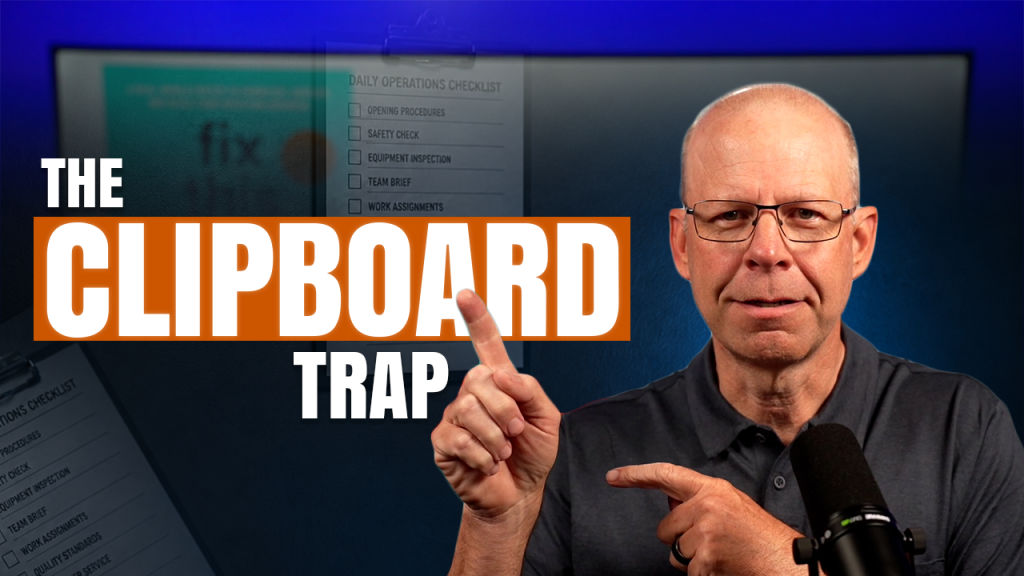
The bathroom checklist example: A checklist that requires someone to remember to use it is a patch on the Memory Trap... that itself has a Memory Trap. The checklist didn't solve the problem. It just moved the problem.
Patches are workarounds disguised as systems.
- Memory Trap → checklist, reminder, calendar invite
- Control Trap → approval step, sign-off
- Variability Trap → review, quality check
- Visibility Trap → report, dashboard
Operational debt is like financial debt but not on your balance sheet. Research shows it can cost up to 25% of your revenue. Every checklist, approval, review, and dashboard adds weight.
Operational debt creates three types of drag:
- Speed (every patch slows things down)
- Confusion (new employees can't figure out the buried system)
- Brittleness (patches don't adapt; changes break them)
The alternative isn't more patches. It's seeing the traps for what they are.
Patching is reactive—you see a problem, you slap something on it. Managing is intentional—you ask: Can I remove this step? Can I redesign so the trap doesn't exist? Can I automate so humans don't have to remember?
"Patches add to the process. Managing subtracts from it."
"Remove before you automate. Simplify before you systemize."
If you automate a trap without fixing it first, the trap gets amplified. Now you have faster, more consistent chaos.
The key insight: Seeing the traps is the advantage. Once you see them, you can't unsee them. You're not seeking perfection. You're seeking awareness.
Your action: Find one patch in your business. A checklist nobody uses. An approval that's rubber-stamped. A report nobody reads. Ask: Is this solving the problem or just moving it?
Next episode: How to audit a process before you automate—Clarify the Flow.
Got a business question? Ask Scott here: scotttodd.net/ask
📜 Full Transcript (Click to expand)
I've got something to tell you. And this might be hard to hear, but the four traps that we've been discussing, the control trap, the variability trap, the memory trap, and the visibility trap, they never go away. You can manage them, you can minimize them, but you can never fully eliminate them from your business. They're baked into every process you have.
As your business grows, they continue to reappear. And here's the problem. When most business owners see a trap, their instinct is to patch it. Add a checklist, add an approval, add a reminder, add a review, add something, but patches do not fix problems. Patches create something entirely
different within an organization, something that silently drags your business down. And today I'm going to show you why the fixes that you think you might be solving are actually making things worse. But first, let me talk about that bathroom checklist. Welcome to Fix My Business. I'm your host, Scott Todd. I've built multiple seven figure businesses after leaving corporate America.
And this show is dedicated to helping you build a business that you love. Over the last several episodes, I've gone deeper into the four traps. I'll say them again, the control trap, the variability trap, the memory trap, invisibility trap. And in fact, I'm gonna say them frequently on this episode because I want you to remember them. I want you to be able to visualize them. And if you haven't consumed the past episodes,
Go back to episode 54. This is 59, so you gotta go back now six episodes, and this is a whole series. this is where I introduced all four. And today I need to tie it all in together. Because when you understand that seeing the trap is only half the battle, well then you're gonna be poised to really doing things within your business is gonna solve a lot of problems. The other half,
of this whole seeing thing is understanding what not to do when you see these traps. So here's the bathroom checklist story. You've seen these, right? You walk into a business's bathroom and on the back of the door, there's like this, you know, holder. Sometimes it's a clipboard, sometimes it's like a plexiglass holder and it holds a checklist. Sometimes that checklist is there, sometimes it's not.
Sometimes it's an old piece of paper and sometimes they're actually using it. The concept is simple. Every hour or some other timeframe, someone is supposed to go in, check the bathroom, make sure it's clean, and then initial the sheet. It sounds like a system, right? It sounds like someone really solved the problem. But here's the thing, that checklist that requires
Someone to remember to go do it every hour without fail? What is that? That's a patch on the memory trap. That itself has a memory trap. See, the checklist doesn't solve the problem. It just moves the problem. And now there's two failure points instead of one.
The bathroom might be dirty and the checklist might not be getting filled out. I've walked in the bathrooms where the checklist hasn't been touched in days. So have you. The initials just magically stopped. Nobody noticed. Nobody cared. The patches failed silently. And that's what patches do. They feel like solutions when we're creating them, but they're not because patches are workarounds.
that get disguised as systems. And when you see a trap within your business, the instinct, the first instinct is to create a patch for it. And I get it. You see a problem, you want to fix it, you want to fix it fast, so you add something. If you see the memory trap, you add a checklist. You add a reminder, you add a calendar invite.
When you have something that's a control trap, you add an approval step, you add a sign off, you're gonna take control back of a process. In the variability trap, you add another review, you add quality checks, you add someone to overlook things.
For the visibility trap, you add a report, you add a dashboard, but none of these are actually bad. But here's what happens over time. Every patch you add creates operational debt. And operational debt, just like financial debt, but guess what? It's not even on your balance sheet. It's some accumulated weight.
that every workaround begins to put onto the business.
This is where we get things that say like, well, this is the way that we do it here.
And research has shown that operational debt could be worth up to 25 % of your company's revenue. Think about that for a second. Think about that number. There's some hidden debt that's not anywhere on a financial statement. You cannot see it, but it's putting a drag on your company. And guess what? Just like financial debt, it has interests. Because every checklist requires someone to use it.
And please don't understand, I'm not anti checklist. mean, pilots use checklist religiously and that's a great thing. Okay. But when we're using checklist as a patch and somebody's going to forget to do it, that's not a solution. See, every approval step adds time to the process and it also creates a bottleneck.
Every review that somebody has to now go do adds labor and that slows down the output. And every dashboard requires someone to look at it and someone to act on what it's showing. See, the patches pile up and one adds drag and then that drag gets multiplied and compounded.
Think about your business right now. How many checklists do you have that nobody looks at? How many approval steps are just there, but they're rubber stamped? How many reports get generated that are never read? That's operational debt. And if you're like most people within this audience, we're not talking about a huge company. You're talking about a handful of people, but yet you've created bureaucracies to solve problems, but you're putting that operational drag on at a very early time.
And that's what drags down the business. Operational debt creates drag in three ways. First comes to speed. Every patch slows something down. That approval, it adds time to the process. If somebody has to review something, that's another bottleneck. A checklist that basically adds more time to something.
It might only be a 10 minute checklist. It might be a 30 second checklist, but it feels like 30 minutes because nobody wants to do it. Multiply that across all the processes that you build in your business every single day, every single employee. And that drag adds up. Drag two is confusion. You see, the more patches that you have, the harder it is to understand how work actually gets done.
A new employee can't figure out the system because the system is buried under layers of workarounds. I've worked in corporate America that has layers and layers of work around. Well, we do it this way, this time, we do it this way, this time, and then the employees, they get confused. So guess what? They don't follow the process anymore. They just go do it their own way, the way that they have to do to get the work done.
I've seen businesses where it looks like there's real processes but nothing's been documented, or the documented process is the patch. Okay, so you have this documented process that's like, well, this is how we do this, but yet the employees do not do it that way. You can have a process that looks like this, but the employees do it like this. And that's operational dragon that comes from patches, because the employees are having to patch what...
The process is broken. Drag number three is brittleness. A business with lots of operational debt is fragile. When something changes, whether it's a new employee, a tool, a new customer, the patches start to fail because patches were built for a specific situation. They don't adapt. And then so what happens is when that fails, what's the instinct?
is to add more patches to fix the patches that stopped working. And there is how the debt compounds. Now, the alternative is not more patches. The alternative is seeing the traps for what they are. And here's the truth that I told you at the very beginning. The traps never leave. See, the control trap, the variability trap, the memory trap, the visibility trap, yeah, I'm going to do them all over again.
They exist in every process of your business. No matter how many times we find it, they're still there in some form. Even if you remove the traps, you have to be aware that they can pop back up again. And that's not bad news. It's actually good news because once you know they're there, once you know these traps exist, now you can manage them intentionally instead of patching them reactively.
Let me explain the difference. see, patching is reactive. You see a problem, you slap something on it, a checklist, reminder, approval, done, you feel good. But managing is intentional. You look at the process, you identify where the traps are, and you ask, how can I remove this step entirely? Or can I redesign this process so that the trap doesn't exist?
Can I automate this so humans don't have to remember? You see, patches add to the process.
managing quite often subtracts from it. I talk about this back in episode 52 when I introduced the scale framework. The first question isn't how do I automate this? The first question should really be, should this step even exist? Remove before we automate. Simplify before we systemize. Because if you automate a trap,
that you don't first fix, what happens is the trap gets amplified by the automation. Now you have faster, more constant chaos. And here's the key insight. Seeing the traps is the advantage. Most business owners don't know these traps exist. So they keep patching. They keep adding checklists. They keep adding approvals. They keep adding reviews.
And then they wonder why their business feels heavier every year. But you, you've spent the last several episodes learning what to look for. Control, variability, memory, and visibility. You know the diagnostic questions. You know the escape routes. And once you see them, you can't unsee them. They become obvious.
You'll walk into any business and spot those traps. I do it all the time. It's very, very annoying. I write about it almost daily on my blog. Like, here's a trap, here's a You start to see things.
You'll walk into that bathroom and you'll see that checklist on the wall and think of me. Just kidding. You'll think of the memory trap and how that's another memory trap. And you'll see the operational debt. You'll look at your own processes and start to notice the patches that you've accumulated over the years. And then you'll ask, is this actually solving the problem? Or is it just moving the problem?
to somewhere else. That awareness is the advantage. In business, you're not seeking perfection.
You're seeking awareness. Now here's where things are heading for this show. In the next episode, I'm going to show you how to look at a process holistically before you try to automate it. Because this is where most people get it wrong. They see a process that's broken and they think, ⁓ I'll just automate it. So then they bake in every trap into the process, every patch, every operational debt.
just gets compounded right into the automation. And that is compounding the chaos. That's locking in the problem. In the C in the scale framework, I identify that C stands for clarify the flow. And this exists for this exact reason. Before you build anything, you want to see the whole picture. You have to find where the traps are hiding.
You have to decide, remove or redesign or eliminate, and then we can deal with automation. And that's what our next episode's about. So here's your action plan for this episode. Look at one process in your business, just one, start with one and find a patch. Find some sort of a patch that you've added. Where's the checklist that nobody uses? Where's the ⁓ approval that's just rubber stamped?
Where's the reminder that someone ignores? Where's the report that nobody reads? Those are your patches. That's your operational debt. And ask yourself, is this solving the problem or is it just moving the problem somewhere else? That's the first step. That's the first step towards managing the traps instead of patching them.
And in the next episode, I'll show you how to audit a process before you automate, how to find the traps, how to decide what to remove, and how to avoid amplifying chaos. And if you have a business question, head over to scotttodd.net forward slash ask. I read every single submission and I will see you in the next episode.