


Show Notes
Mall developer Alfred Taubman figured out that you can build the best mall in the world, but if people won’t walk into the stores, it flops. He called the problem threshold resistance — if getting in the door takes too much work, people just don’t go.
The same thing happens with your call to action.
The diagnosis: Most CTAs ask for too much. We all want the sale today, because sales pay the bills. But if the ask is bigger than what the buyer is ready to commit to, they walk.
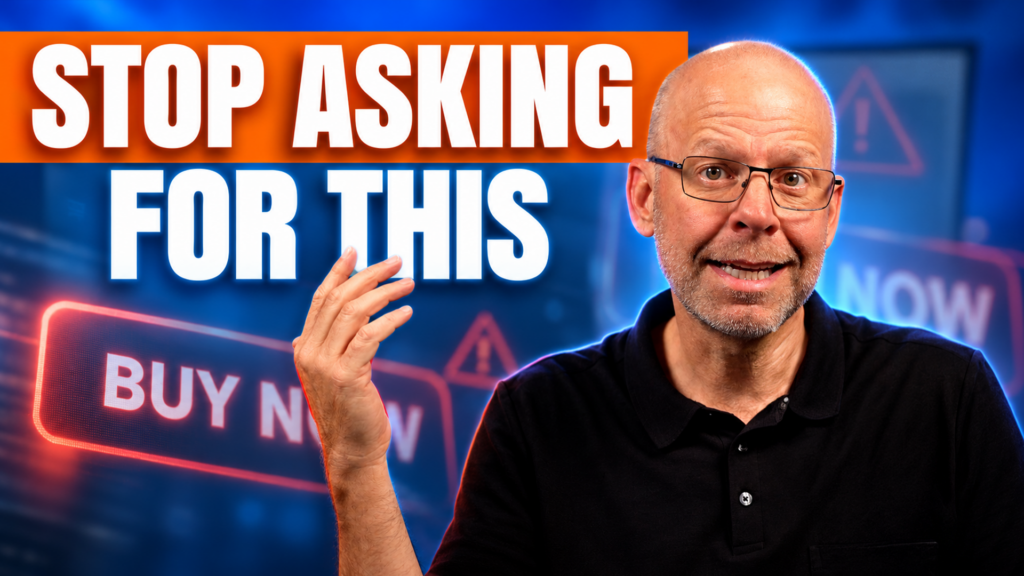
Match the ask to the commitment level. A book might be an impulse buy. A property isn’t — even when the monthly payment is low, the commitment is high. “Buy now” on a high-commitment purchase puts the brakes on.
Make the next step a micro step. What’s the smallest thing they won’t say no to? Request information. Download a property report. Tell me about your situation.
The attorney example: “Book a 30-minute consultation” sounds inviting, but with legal or medical the result might be something you don’t want to hear. That makes it scary. “Tell me a little about your case” or “download this” is a smaller door.
Honor the micro-commitment. Once they take the small step, don’t immediately jump to the ask. They’re not ready yet.
How to test it with AI:
Take two CTAs you’re considering — A and B. Give your AI model the full context: whether the buyer is cold or already in your world, what the offer is, the pricing, everything. Let it ask you questions. Then have it simulate a thousand prospective buyers and compare response rates between the two.
The warning: The numbers will be wrong. The model is wildly optimistic — it’ll tell you cold traffic converts at 10-15%. It doesn’t. Scott has had to walk it back every single time, and it agrees every single time.
Use it for comparison, not prediction. You’re not looking for a forecast. You’re checking whether you’ve lowered the resistance enough, or whether you’ve picked the highest-resistance option without realizing it.
Got a business question? Ask Scott here: scotttodd.net/ask
📜 Full Transcript (Click to expand)
What can you learn about your call to action from studying the design of the mall? In this episode, we're going to look at that and we're going to look at how we can use AI to help us understand exactly how strong our call to action is. Welcome to Fix My Business. I'm your host, Scott Todd. I've built multiple seven-figure businesses after leaving corporate America. And this channel is dedicated to helping you do the exact same thing.
There's a mall developer named Alfred Taubmann And the thing is, is that as he was developing malls, he would look at the design and he knew that you could have the best mall, you could have the greatest layout, you could have all of the bells and whistles of the mall. But if no one walked into the stores, the mall would flop. He knew that his job was to get people.
To the stores, but then the stores had to do their part, which was to make it opening and welcoming and warm to come into the stores. And after studying this for a very long period of time, he actually developed this concept of threshold resistance. And threshold resistance ultimately says that if the threshold to get into the store was too complicated, doors or basically the way that it wasn't open.
then people wouldn't go in there. If they had to go through too much to get into the store or work around it to get into the store, they just wouldn't go. And it reminds me a lot of the call to actions that I see in the marketplace today and the people that I work with will say to me, like, hey, you know, look at this ad or look at this that I'm doing this marketing. And one of the things that I've noticed is that oftentimes the call to action is too great.
So, as an example, we we all want sales today. We all want to make sales because, well, the sales pay the bills. But if the call to action is too great, then what happens is we we repel buyers. They leave. They're it's too much for them. So they walk away. So depending on our offer and depending on what we're selling, we could have something that is an impulse buy. For example, a book. A book might be an impulse buy.
Or maybe it's not. Maybe you're going to study that book. And as you go higher in the commitment level and also higher in the price range, the next step has to change. That call to action has to change. So let's take an example. In my world of real estate, for example, where you have people that are selling properties, even though the monthly payment might be something that's super low, the commitment is high.
And if the call to action comes down and says, buy now, invest today, do these things, well, then people are going to put the brakes on. They're going to be less likely to take the next step because now they're thinking about it. And so the real challenge for us is to really think through hey, how can we make the next step super small? A micro step, maybe.
What's the next logical step that they might not say no to? Is it request information? And oftentimes when I'm working with people, I'll say to them, hey, you can offer a property report, for example. But in your world, whatever it is, think about the next piece because it might your ask might be bigger than what they're willing to commit to. Maybe you're asking them to schedule an appointment. Attorneys do this all the time. Hey, book a consultation call with me. It's 30 minutes.
And it sounds inviting. The problem is that that also sounds scary, especially with something like legal or medical, where the result could be something that we don't want to hear. That's the next piece of it. So could it be, hey, tell me a little bit more about your case? Or here, download this thing, this document about what you're experiencing or maybe maybe what you're thinking about. So how can we make the next step a micro step so that we can just generate it as a lead?
And that's really the challenge that we have as marketers: is how do we take that step? And then when we take that step,
Then what we need to do is we need to make sure that we're honoring the step and we're honoring the microcommitment, that we're not jumping too far ahead and asking them to buy when in fact they're not ready. Now, it is possible to leverage AI for this and probably not the way that you're thinking about. You see, the way that I would run this is I would begin to sit down and think about hey, here's two call to actions that I'm thinking about. I'm thinking about this call to action or this call to action, A or B.
And one of my favorite activities is to go to my AI of choice, whatever it is for you. And I basically ask it hey, simulate 1,000 prospective buyers. Now, this is where context really, really matters because when you're asking it to simulate these prospective buyers, you really need to give it some understanding of one, their relationship to you, that buyer's relationship to you. They're cold, they don't know me. This is their first touch point.
Or it's an email. It's they're they're aware of me, they're in my world, they get emails from me every single week, month, year, whatever it is. Give it the context of your relationship with this prospective buyer because that matters. Give them the offer. This is what I'm thinking. I'm thinking about this, you know, request information versus buy now. Give them the pricing, give them everything you can do. This AI agent, give it everything that you can do.
Tell to ask you whatever questions it has and then let it go to work. And what it will do is it will simulate a thousand prospective buyers. Now, there are models out there that will fire up and basically create this little world, micro world. One of them is Mirofish. Mirofish is a GitHub re, GitHub repo that allows you to go in and create these basically these simulated buyers in their own world.
And when you run this through AI, it's not going to do that per se because it's going to run some math based on these components. But the AI model will basically come back and say, hey, here's your response rate for this offer, and here's your response rate for this offer. And what it's going to do is it's going to look at this from the perspective of the threshold resistance to say, hey, this is this is going to reduce your responses or this is going to drive more. Now, I've done this many times. I've done this.
I don't know, countless times on different offers. And the one word of advice I could give to you is expect the numbers to be wrong. The AI model is going to be very, very optimistic. It's going to say you're on a cold traffic, you're going to get 10 to 15% response rate. No, you're not. No, you're not. So I always have to walk it back down again. And I'm not necessarily looking for the predicted response rate based on what it thinks. What I'm trying to determine is.
Have I lowered the resistance enough that I'm not kind of in the bottom rung? Okay. So that's why the compare and contrast comes in so importantly. Because when you go in and you give it like buy now, that by its nature on most items is going to be the lowest. It could, unless it's an impulse buy item, it's going to be the lowest response rate versus ask for a brochure or ask for information or go read this thing.
See, that's going to have the highest response rate. But the AI model is going to give you a very, very high response. And every time I've done it, I've had to say, no, that's wrong. It's too high. You're too optimistic. you're right. You're right. You're right. So again, our goal is to compare and contrast to see are we where we are with these to make sure that I'm not choosing the highest resistance. And that's really the
The point here is I want you to go and do that. Take your offer, whatever it is, run it through AI with the simulated users or buyers. And then decide: based on that, am I creating confusion in the marketplace? Or is my message and call to action crystal clear? Because when you clear that up, man, it changes the entire ballgame. If you have a business question, head over to scott.net forward slash ask.
And I will see you in our next episode.